According to Off The Pitch’s M&A tracker, football M&A activity over the last five years reached its peak in 2025, with a total of 78 football M&A deals completing globally (up from 62 in 2024). The analysis suggests that this rise in activity was predominantly due to increased US involvement, the ongoing expansion of multi-club ownership groups and a growing appetite for investment in clubs outside of the traditional elite.
US investment in football is hardly a new phenomenon but it does still certainly seem to be on the rise – of the 78 football M&A deals that Off The Pitch had tracked in 2025, over half involved US investment (as set out in the graph below).
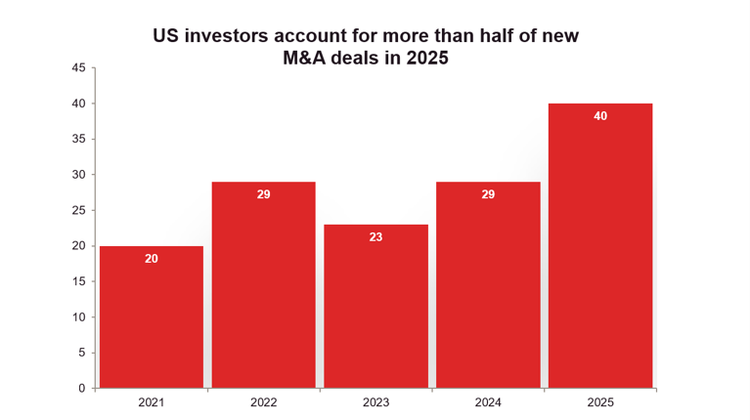
Source: Off The Pitch M&A Tracker
These transactions included Woody Johnson’s acquisition of a minority stake in Crystal Palace, Andrew Cavenagh and the San Francisco 49ers Enterprises’ purchase of a majority stake in Rangers, ALK Capital’s acquisition of Espanyol (to complement its ownership of Burnley), as well as potentially the largest football M&A transaction of the year – Apollo’s acquisition of a majority stake in Atletico Madrid at a reported £2.2 billion valuation.
Rising valuations
Our 2023 report analysed how “closed leagues” and the finite number of franchises in the US has typically meant that US sports clubs have higher valuations than their European counterparts and this has certainly continued over the past few years. The rapid growth in sports franchise valuations is illustrated by Forbes’ 2025 report on the world's 50 most valuable sports teams, which noted that “six years ago, the world’s most valuable sports team was worth $5 billion…now, that figure wouldn’t even crack the top 50”. Following the introduction of Formula 1 teams to Forbes’ analysis in 2025, 44 of its top 50 are US-based sports teams (with only Real Madrid, Manchester United, Ferrari, Mercedes, Barcelona and Liverpool making the top 50 from outside of the US).
These rising valuations, together with the fact that the American economy has grown faster than that of the EU or UK in recent years, have generally meant more US investment both abroad and in their domestic game. Following NBC Sports’ $2.7 billion six-year media rights deal in 2022 – and no doubt accelerated in large part by the US hosting the 2025 FIFA Club World Cup and co-hosting the 2026 FIFA Men’s World Cup – football is becoming increasingly popular in the US. According to a new study by The Harris Poll, 72 percent of Americans say that they are interested in football and, in 2025, US Soccer (the governing body of football in the US) generated $263.7 million in revenue (a 37 percent increase from 2024) and this increased popularity is undoubtedly a factor in the growing investment in European football. Whether or not this appetite for investment continues at the same pace after the World Cup, particularly in light of tariffs and increasingly unstable geopolitics, remains to be seen but there are plenty of other signs that indicate US investment will continue to drive M&A activity in the football sector in years to come.
Multi-club ownership here to stay
Our previous reports1 have analysed the growth in multi-club ownership groups and Off The Pitch’s research notes that this has also continued to generate deal flow across the football sector. ALK Capital (the owners of Burnley) acquired Espanyol in 2025, whilst, elsewhere in the Premier League, Brentford’s holding company acquired AD Mérida and Tony Bloom bought a 29 percent stake in Hearts. PSG and Liverpool have also been rumoured to be looking at satellite clubs. Multi-club ownership is undoubtedly here to stay, although, as discussed in previous reports,2 it is not without its challenges.
In August, Crystal Palace lost their appeal against being demoted from the Europa League to the Conference League as a result of John Textor being the majority owner of Lyon (who had also qualified for the Europa League). As multi-club ownership groups continue to grow, these situations are becoming increasingly common, and multi-club ownership groups are certainly having to be cognisant of the regulations and plan accordingly. Last year, Nottingham Forest owner Evangelos Marinakis reportedly diluted his control of the club in preparation for Champions League qualification for both Nottingham Forest and Olympiakos, whilst Chelsea owners BlueCo had taken similar steps with Strasbourg in case both clubs ended up in the same European competition. More recently, the Friedkin Group claimed that they have an alternative structure in place that would allow both Everton and AS Roma to compete in the same European competition without using a blind trust.
Some argue that UEFA regulation has still not gone far enough, although UEFA has reportedly informed clubs that it will continue to take a hard-line position on multi-club ownership groups competing in the same competitions, which could indicate that maintaining compliance with such regulations may become increasingly burdensome for multi-club ownership groups in the years to come.
The more “sporting” arguments surrounding multi-club ownership groups have also persisted during the last year – most notably with Strasbourg fans’ protests against BlueCo following the sale of Mamadou Sarr to Chelsea and Liam Rosenior’s announcement as Chelsea manager. The Red Bull group – in which Red Bull no longer holds direct ownership stakes in clubs and instead operates as a principal sponsor (presumably in order to comply with the UEFA regulations discussed above) – are also reportedly reconsidering talent placement across their multi-club network under the supervision of Jürgen Klopp, Red Bull’s Head of Global Soccer.
In November, Bournemouth owner Bill Foley even sold his 25 percent stake in Hibernian back to their majority owners, with the Hibernian chairman citing “philosophical differences in our visions for the club”. Whilst the Bournemouth ownership group continues to hold stakes in Lorient, Auckland FC and Moreirense FC, these examples demonstrate the difficulty in agreeing a coordinated strategy across a multi-club portfolio that satisfies all stakeholders. Whilst multi-club ownership is now widely entrenched across the global football sector, the rate of growth does appear to be slowing and it will certainly be interesting to see how the regulatory landscape develops in the coming years, and how club owners respond.
Investors look to lower leagues
The final factor that Off The Pitch noted in their analysis was that investors have turned their attention to lower leagues, which may have contributed to the increase in majority acquisitions; according to their research, majority transactions were up to 50 in 2025 from 35 in 2024, whilst minority transactions stayed broadly stable, with 27 in 2024 and 28 in 2025. City AM also reported that half of all English football M&A deals have involved teams in League Two or lower, which evidences that investors are certainly turning their attention to clubs further down the football pyramid. Majority ownership naturally allows investors to exert greater strategic control, but, as evidenced above, the increase in majority deals has not come at the expense of minority investments.
In the Premier League alone, last summer Woody Johnson acquired a minority stake in Crystal Palace and Gary Lubner and Sir Matthew Vaughn invested in Brentford, where Norton Rose Fulbright advised the club. In our 2023 report, we had discussed the rise of consortia and stakebuilding (largely due to high valuations of elite clubs)3 and this theme, particularly where sector expertise is coupled with capital, has certainly continued. It could even be argued that private equity interest within football has shifted over the years to a preference for minority investment, prioritising yield-like exposure over control, whilst majority transactions for smaller clubs have increased, reflecting the appeal of the wider English football pyramid to a range of investors.
Large transactions for elite clubs have remained elusive in recent years, although it is worth noting that, partly as a result of falling interest rates prior to events in the Middle East, structured debt has started to return to the football sector of late. For example, Everton refinanced their stadium debt with institutional investors and Manchester United are reportedly exploring external financing, or even public-private partnerships, for their new stadium. Should interest rates continue to fall in 2026 and into 2027, it may be that we do even see the return of “bumper” deals like the acquisition of Chelsea and Jim Ratcliffe’s investment into Manchester United of the past few years.
The importance of the Women’s game in the football M&A landscape
Women’s football has also become an increasingly important segment of the overall football M&A landscape. Within the WSL, Everton Women, Aston Villa Women and Chelsea Women all announced minority investments in 2025. Elsewhere, Bex Smith, the former New Zealand captain, led a takeover of Montpellier HSC Féminines last year and stated her intention to create a multi-club ownership group, which is only one of a number other multi-club ownership groups that have started to spread across the women’s game. More recently, Smith’s investment group has acquired a 49 percent stake in Sweden’s FC Rosengård, the country’s most successful club with 14 national titles, and is reportedly turning its attention to three additional markets: England, Spain and Germany.
Our 2024 and 2025 reports discuss the regulatory framework of women’s football in the UK in detail4 but, at present, the IFR does not regulate the women’s game. This is as a result of the UK government’s agreement with an independent review led by Karen Carney, which recommended that the women’s game should be given the opportunity to self-regulate rather than moving immediately to independent statutory regulation. As revenues in the women’s game continue to grow, however, it will be interesting to monitor how the regulatory framework develops and, in turn, what impact this has on club ownership.
Even though domestic broadcasting rights in the UK, and European football media rights generally, have seemingly plateaued over the last few years, the Premier League’s international broadcasting rights revenues (and elite clubs’ wider broadcasting and commercial revenues) have continued to soar. Despite this, 90 percent of English football clubs are expected to post losses for 2025 and high-risk spending to achieve promotion, which often relies on equity injections from owners, has persisted further down the football pyramid.
Our report last year discussed how the Profitability and Sustainability Rules (PSR) could lead to higher valuations for football clubs going forward as they become more profitable;5 however, given PSR has now been replaced with the Squad Cost Rules (SCR), we may need to wait a little longer to see if this comes to fruition. Many commentators have suggested that football M&A activity in 2025 reflected a maturing market, with global capital continuing to flow into the game through a broader mix of strategic acquisitions, growing multi-club networks and investment activity of varying levels across all tiers of the pyramid.
With this in mind, perhaps the only thing we can predict with certainty is that we would expect to see a broad range of investment activity continue in the years to come.
Footnotes
-
Norton Rose Fulbright, Keeping possession: Ownership trends in English Premier League football (2023); Norton Rose Fulbright, Keeping possession: Ownership trends in English Premier League football (2024).
-
Norton Rose Fulbright, Keeping possession: Ownership trends in English Premier League football (2023); Norton Rose Fulbright, Keeping possession: Ownership trends in English Premier League football (2024).
-
Norton Rose Fulbright, Keeping possession: Ownership trends in English Premier League football (2023).\
-
Norton Rose Fulbright, Keeping possession: Ownership trends in English Premier League football (2024); Norton Rose Fulbright, Keeping possession: Ownership trends in English Premier League football (2025).\
-
Norton Rose Fulbright, Keeping possession: Ownership trends in English Premier League football (2025).\