Introduction
An important component of doing business is the ability to obtain open and candid advice from your lawyer without the threat that the advice received will have to be disclosed.
Equally important for individuals and businesses is the ability to prepare for or defend a lawsuit without having to disclose your case preparation to the other side, or to carry out an internal investigation into potentially sensitive issues confidentially.
While some form of privilege or confidentiality exists in relation to communications with lawyers and material prepared for litigation or investigations in a number of jurisdictions in the world, the precise scope of that protection and when it applies varies across jurisdictions. The approach to privilege differs between common law and civil law jurisdictions largely because civil law jurisdictions do not adopt the same obligation of disclosure in litigation, meaning issues of privilege arise less often. Differences also exist between each individual jurisdiction. There is no single law on privilege in the US, as both Federal and State laws apply.
These differences may mean that a document or communication which is privileged in one jurisdiction may not be privileged in another jurisdiction. In a world where disputes and investigations increasingly involve multiple jurisdictions, each with a different view on what is privileged, navigating the boundaries of privilege across borders is a complex matter.
In this Guide, we focus on two jurisdictions which have strong legal precedent in relation to privilege: England and the United States.
In both England and the United States, parties may be obliged to disclose documents during litigation, arbitration, or an investigation. For example, as a matter of English civil procedure, while there are a range of options for the scope of disclosure, a party is usually obliged to disclose to its adversary documents which adversely affect its case and/or which support the adversary’s case. In the United States, parties have similar obligations under the Federal Rules of Civil Procedure and analogous state rules of procedure. That is, the parties must provide a copy or a description of the location of all documents that they may use to support a claim or defense and must also provide copies of requested documents that may support their opponent’s claims or defenses. Similarly, there are a number of ways in which corporate entities and individuals may be required to disclose sensitive material in the course of an external investigation.
In both England and the United States, the definition of what qualifies as a document is broad. A document may be, among other things, an email, a text message, a board presentation, a voicemail, or metadata.
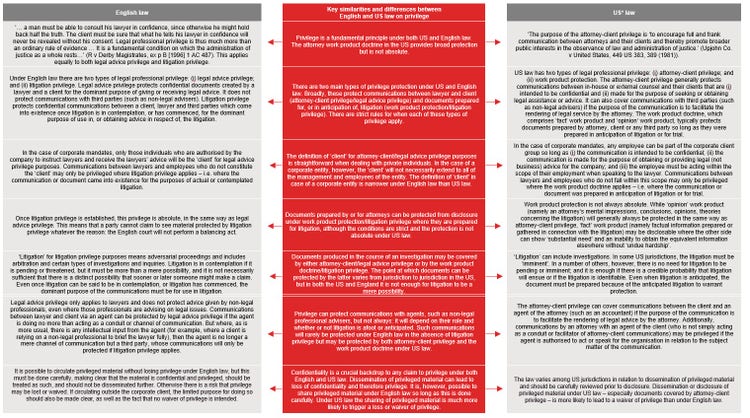
There are two main types of privilege protection under US and English law. Broadly, these protect communications between lawyer and client (attorney-client privilege/legal advice privilege) and documents prepared for, or in anticipation of, litigation (work product protection/litigation privilege). However, there are strict rules for when each of these types of privilege apply. It should not be assumed that all communications with lawyers or documents prepared in the context of litigation or an investigation will be privileged.This Guide sets out the essential law on privilege from an English and US law perspective. It also sets out, in the table on page 7, some of the key similarities and differences between the two jurisdictions, focusing on:
- Who is the ‘client’ for the purposes of legal advice privilege and attorney-client privilege.
- When documents may be protected from disclosure under work product protection/litigation privilege where they are prepared for litigation.
- When documents produced in the course of an investigation may be protected by privilege.
- When communications with third parties/non-lawyers may be protected by privilege.
Privilege issues are fact-specific. For particular questions, please contact a lawyer at Norton Rose Fulbright.
English law on privilege
Legal advice privilege
Legal advice privilege protects confidential documents created by a lawyer and a client for the dominant purpose of giving or receiving legal advice.
Legal advice privilege applies in both contentious and non-contentious contexts.
The policy rationale for this category of privilege is that ‘a man must be able to consult his lawyer in confidence, since otherwise he might hold back half the truth. The client must be sure that what he tells his lawyer in confidence will never be revealed without his consent. Legal professional privilege is thus much more than an ordinary rule of evidence…It is a fundamental condition on which the administration of justice as a whole rests… ’1
A ‘lawyer’ for the purposes of legal advice privilege includes not only solicitors, barristers and in-house lawyers, but also those supervised by qualified lawyers, such as trainee solicitors, paralegals, clerks and legal secretaries, as well as other legal advisers, such as patent attorneys. As a matter of English law, privilege can also attach to advice provided by foreign lawyers provided that they are admitted to practice in their home jurisdiction. This can also include foreign in-house lawyers and there is no need to consider the training or experience of an individual foreign lawyer for legal advice privilege to apply.2
‘Lawyer’ does not, however, extend to other professionals, such as accountants, even where they are providing legal advice, for example on tax issues.3 In addition, while English law does not draw any distinction between in-house lawyers and lawyers in private practice, the Court of Justice of the European Union has held that communications between a company and its in-house lawyers in the context of EU competition investigations are not protected by legal advice privilege and may be inspected by the European Commission.
This is on the basis that, unlike external lawyers, in-house lawyers are not deemed sufficiently independent for their communications to be protected by legal advice privilege.4
The definition of ‘client’ is straightforward when dealing with private individuals. In the case of a corporate entity, however, who the ‘client’ is will be a question of fact, and it should not automatically be assumed that the ‘client’ will necessarily extend to all of the management and employees, however senior, of the corporate entity for legal advice privilege purposes. Instead, the ‘client’ is narrowly construed to mean only those individuals within the company who are authorised to instruct the lawyers and receive legal advice on the entity’s behalf on the matter in question.5 Those individuals who instruct lawyers and the individuals who receive legal advice may be the same or they may be different. There is no set limit to the number of members of the inner ‘client,’ save to say that the bigger the group is, the more difficult it may be to justify.
Communications between a lawyer and employees at the corporate client outside the ‘client’ circle will be treated as communications with a third party and will not be covered by legal advice privilege. Such communications will only be privileged if litigation privilege applies (described below).
Where a client appoints an agent to liaise with its lawyers on its behalf, whether or not the agent’s communications with the lawyer are legally privileged will depend on the role of the agent. If the agent is doing no more than acting as a conduit, or channel of communication, between lawyer and client, as a translator or interpreter might do, then those communications may well be covered by legal advice privilege.
However, where (as is more usually the case) there is any intellectual input from the agent – for example where a client needs to rely on an agent’s particular expertise in order to be able to provide full instructions to the lawyer – then the agent will not be treated as a mere channel of communication but as a third party, and the communications between lawyer and agent will not be protected by legal advice privilege. Such communications may be protected by litigation privilege if the requirements for litigation privilege are met.
The Court of Appeal in Civil Aviation Authority v R (on the application of Jet2.com Limited)6 confirmed that the dominant purpose test, which is an established requirement of litigation privilege, also applies to legal advice privilege.
Previously, the consensus was that intra-client documents were only privileged if they disclosed the substance of a communication between lawyer and client that was itself privileged. However, Aabar Holdings v Glencore held that communications between members of the inner ‘client’ or created by members of that group may benefit from legal advice privilege if created for the dominant purpose of seeking legal advice.7 This change only applies to the narrowly defined inner ‘client’ and it is only a first-instance decision, but, unless overruled by a higher court, it will have significant effects.
Extra care should be taken when seeking the input of both lawyers and non-lawyers in the same communication. Although privilege will be assessed within the context of the “continuum” of communications between lawyer and client, if the dominant purpose of a communication is to obtain the commercial views of the non-lawyer addressees, the communication will not be protected by legal advice privilege. Multi-addressee emails should be considered as bilateral communications between the sender and each recipient for the purpose of ascertaining whether legal advice privilege applies.8
Legal advice privilege arises in the context of giving or receiving legal advice. Given that lawyers often give a mixture of legal, commercial and administrative advice, this can lead to a dispute over whether the advice is privileged. In practice, however, this requirement is widely construed to cover advice given in a “relevant legal context.”9
This can include a lawyer’s presentational advice on how to present a case to an inquiry, but may be lacking where the lawyer is acting as general business adviser and advising on, for example, investment or finance policy or other business matters.10
Litigation privilege
Litigation privilege protects confidential documents between a client, lawyer and third parties which come into existence once litigation is in contemplation, or has commenced, for the dominant purpose of use in, or obtaining advice in respect of, the litigation.
The rationale is that a litigant should be allowed to prepare for litigation without fear that any documents produced for that purpose will subsequently have to be disclosed.
Litigation privilege is therefore wider than legal advice privilege as it extends privilege protection to communications with and documents prepared by third parties, so long as those communications and documents are for the dominant purpose of actual or contemplated litigation. There is no need for a lawyer to be included in the communications or for a lawyer to have prepared the document in question.
The litigation must be adversarial in nature, not inquisitorial. It will include court, arbitration and employment cases and proceedings before a foreign court, and certain disciplinary proceedings which are adversarial in nature.
Whether investigations and inquiries can be ‘litigation’ for litigation privilege purposes will depend on the nature of the investigation or inquiry and how it is carried out.
Litigation will not include processes which are purely administrative or fact-finding. In the Three Rivers litigation, for example, it was accepted that the Bingham Inquiry, set up to investigate the collapse of BCCI, was not adversarial and therefore litigation privilege did not apply. Lord Scott stated:
‘The Bingham Inquiry could not have been described as adversarial. It was, as inquiries invariably are, an inquisitorial proceeding.’11
Similarly, a purely internal investigation (to address, for example, internal ethical or governance concerns) will not constitute litigation.
However, litigation privilege may be available where the purpose of the internal investigation is to defend genuinely anticipated claims, be they from third parties or from a regulator.
In practice, the nature of some inquiries and investigations may change over time from being fact-finding to adversarial, allowing litigation privilege to apply to the later if not the earlier stages.
Exactly when a process becomes sufficiently adversarial to be treated as litigation varies from case to case. In the course of regulatory proceedings, the service of a formal document by the relevant regulator stating its legal case against the company is likely to signal that litigation is in contemplation. The stage at which an investigation becomes “confrontational” also provides guidance as to whether the investigation will be sufficiently adversarial to constitute litigation for litigation privilege purposes.12
Litigation privilege will only apply where litigation is afoot or contemplated. “Contemplated” has been variously held to mean “anticipated”, “apprehended”, “pending” or “threatened”. Litigation must be more than a mere possibility13, and it is not necessarily sufficient that there is a distinct possibility that sooner or later someone might make a claim. It is not necessary for there to be a greater than 50 percent prospect of litigation.14 This is a matter of fact to be determined by the court on the basis of all available evidence. Contemporaneous documents setting out the client’s understanding are very important when corroborating a claim to litigation privilege.15
In The Director of the Serious Fraud Office v Eurasian Natural Resources Corporation Ltd,16 the Court of Appeal considered that the first instance Judge had been wrong “to suggest a general principle that litigation privilege cannot attach until either a defendant knows the full details of what is likely to be unearthed or a decision to prosecute has been taken. The fact that a formal investigation has not commenced will be one part of the factual matrix, but will not necessarily be determinative”. Although a party anticipating possible prosecution will often need to make further investigations before it can say with certainty that proceedings are likely, that uncertainty does not in itself prevent proceedings being in reasonable contemplation.
Even once litigation can be said to be in contemplation, or litigation has commenced, the dominant purpose of the communications must be for use in the actual or contemplated litigation.
The ‘dominant purpose’ has been described as the ruling, prevailing, paramount or most influential purpose. To the extent that a communication has more than one purpose, a court will assess its purpose objectively, taking into account all the circumstances, meaning the terms of reference within the document will not be conclusive.17
In Rawlinson and Hunter Trustees SA and others v Akers and another18 the Court of Appeal upheld a decision that there was no litigation privilege in five reports obtained by liquidators, where the liquidators had failed to show that the documents had been produced for the dominant purpose of litigation. In this case, the first duty of the liquidators was not to further the litigation but instead to obtain information simply to establish what if any assets or liabilities existed and what if any steps were open to the liquidators to collect in the assets or to reduce or discharge the liabilities.
There are conflicting authorities as to what the position is where there are two equally dominant purposes.
The House of Lords case of Waugh v British Railways Board19 is authority that the document should be disclosed, although the fact that this was a public authority case may have influenced the decision.20 The Court of Appeal in Re Highgrade Traders Ltd21 distinguished Waugh in reaching the conclusion that two objectives of a report were ‘quite inseparable’. The court considered the report to be privileged on the basis that litigation was inevitable.
In The Director of the Serious Fraud Office v Eurasian Natural Resources Corporation Ltd,22 the Court of Appeal commented that in both the civil and the criminal context, seeking to head off, avoid or even settle reasonably contemplated proceedings is as much protected by litigation privilege as resisting or defending such contemplated proceedings. However, documents created for the dominant purpose of discussing a purely commercial settlement (for example between a company’s board of directors) will not be protected by litigation privilege.23
Other types of privilege
There are other types of privilege under English law which may also be relevant depending on the circumstances in question.
Joint privilege can arise either where two or more parties are clients of the same legal adviser through a formal or informal joint retainer, or where the parties have a joint interest in the subject matter of a privileged document or communication at the time that it comes into existence (as may arise between trustee and beneficiary; parent company and wholly-owned subsidiary; company and director; and partners). The significance of joint privilege is that it cannot be waived by one party without the consent of the other, it can be asserted against the rest of the world, and it can be used by either party to obtain disclosure of the other party’s otherwise privileged documents so long as they concern the joint purpose or interest.
The case of R (Stewart Ford) v Financial Services Authority [2012] EWHC 997 (Admin) sets out a five-stage test to determine whether joint privilege arises where there is no formal joint retainer, and found that certain documents were privileged in the hands of both the company in question (Keydata) and three of its executives, such that disclosure of those documents on behalf of Keydata as part of an investigation by the FSA (as was) should not have taken place without the executives’ consent.
Common interest privilege arises where one party shares an already privileged document or communication with another party with a common interest in the subject matter of the document or communication at the time when the document or communication is shared (rather than when it came into existence, as in the case of joint privilege)
This is common in litigation where two or more separately-represented parties face a common adversary, or where a company communicates with its insurer with regard to ongoing litigation. It is important for inter-party disclosure to take place on a common interest basis to defend against arguments that privilege has been waived. Like joint privilege, the shared document or communication remains privileged against the rest of the world. Unlike joint privilege, common interest privilege does not give the party to whom disclosure has been made the right to demand disclosure of further privileged material from the disclosing party.
Without prejudice privilege is founded on the public policy of encouraging litigants to settle their differences rather than pursue them to the bitter end. The rule applies to exclude from evidence all negotiations, whether oral or written, genuinely aimed at settlement of an existing dispute. Although not definitive, it is common practice to mark such communications ‘without prejudice’ so as to minimise the risk that a mistake is made when preparing documents for disclosure.
Privilege against self-incrimination protects an individual from being compelled to reveal information if doing so means it is reasonably likely that proceedings will be commenced that expose them to the risk of any criminal charge or sanction. A number of statutes expressly preserve the privilege against self-incrimination (for example paragraph 20 of Schedule 2 of the Data Protection Act 2018). Where a statute does not expressly preserve or abrogate the privilege, the position will be a matter of construction of the statute in question24 – although clear language will be required to show that Parliament intended to abrogate the privilege.
Waiver of privilege
As stated above, in order for a document or communication to be protected by privilege it must be and remain confidential. To the extent that a document or communication ceases to be confidential, therefore, privilege will be lost.
This may occur where privileged documents are referred to in open court or in witness statements or inter-party correspondence. The general rule is that privilege will only be waived by reference to the contents of legal advice, and not by reference to its effect.25 The court will consider the extent the privileged material has been relied on and the purpose of that reliance. Recent cases have cautioned that a party cannot simply “cherry pick” privileged material to support its case and any decision to refer to privileged material should be considered carefully as it may lead to further disclosure being required.26
There is also the risk that privilege may be lost when circulating legal advice to a wide group of people beyond the ‘client’ group.
This does not mean, however, that privileged material can never be disseminated under English law for fear of losing privilege.
It may, for example, be necessary to disseminate legal advice beyond the ‘client’ group within a company in order for it to be discussed further or for action points to be carried out. The Court of Appeal in Jet2.com recognised that legal advice is not given for hypothetical purposes but to be considered and applied by the client. It said that it was well-established that legal advice privilege therefore covered not only a document from a lawyer recording legal advice and the client’s own written record of that advice, but also any communication passing on, considering or applying the legal advice internally.27
It is therefore possible to share privileged material within the ‘client’ without losing privilege in such circumstances, but care must be taken to ensure that the advice is not disseminated to more people than necessary. The danger of disseminating the advice too widely is that confidentiality – and therefore privilege – is lost.
One option, when disseminating legal advice within a corporate entity, is to explain that the advice is confidential and privileged, should be treated confidentially and not be circulated any further, and is provided expressly without waiver of privilege.
Unless the sender is an in-house lawyer giving legal advice, so far as possible the sender should refrain from providing any written commentary on the advice. While not determinative, marking documents as privileged and confidential – and not for onward distribution – can assist in maintaining privilege and at least shows that the issue of privilege has been considered, and may help to avoid accidental disclosure. Electronic Portals and/or read-only documents can be used in appropriate cases.
The same risks arise when circulating legal advice to third parties outside the corporate client, including to auditors and regulators. In addition to the above safeguards, it will be prudent to specify the limited purpose for which the advice is being disclosed. In addition, the intended recipient could be asked to sign a confidentiality agreement. This should assist in countering any allegation that privilege has been waived as against third parties.
Where parties share a joint interest in a privileged document or communication – either because they share the same lawyer or because they have a joint interest in the subject matter of the communication at the time that it comes into existence – both parties share the privilege jointly and it can only be waived jointly. Parties may also share a common interest in a privileged document or communication, in which case the privileged document or communication can be shared between such parties on a common interest privilege basis without any loss of privilege.
US law on privilege
Attorney-client privilege
Under US law, the attorney-client privilege generally protects communications between in-house or external counsel and their clients that are (i) intended to be confidential and (ii) made for the purpose of seeking or obtaining legal advice or assistance.28 The law on privilege, while generally consistent across US jurisdictions, is a product of state law and thus can vary from jurisdiction to jurisdiction.
Emails and other information sent by in-house lawyers to company personnel (and vice versa) about business (as opposed to legal) issues are not usually protected by the attorney-client privilege. As a corollary, a document or email will ordinarily not be protected by simply copying an attorney or placing the phrase “privileged and confidential” on the document. Rather, the communication must be made with the purpose of obtaining or providing legal advice or services.
When communications between a client and their attorney serve both legal and non-legal purposes (dual-purpose communications), some US jurisdictions apply attorney-client privilege only if the primary purpose of the communication is to obtain or provide legal advice. Others apply attorney-client privilege if obtaining or providing legal advice is a significant purpose of the communication, even if it is not the primary purpose.29
When external counsel is engaged for a company, there is a presumption that counsel represents only the company that engagedthem, and not any particular employees of the company individually. It is critical for the attorney and the company to be mindful that not every discussion between an attorney and an employee will be covered by the privilege. In general, three criteria must be met for the privilege to apply: (1) the communication must be intended to be confidential; (2) the communication must be made for the purpose of obtaining or providing legal (not business) advice for the company; and (3) the employee must be acting within the scope of their employment when speaking to the lawyer.30
In an internal investigation, the company’s attorney will often be called upon to interview employees. Those interviews can be conducted within the scope of the company’s attorney-client privilege. The attorney needs to make their role clear in these situations. It is best practice for a lawyer (whether internal or external) to give every employee whom they interview a warning (known as an “Upjohn” warning) that they represent the company and not the individual and that the interview is being conducted in order for the company to receive legal advice. The lawyer should also make a contemporaneous record that this warning was provided.31
In the United States, communications involving agents (of the attorney or the client) may also be protected by the attorney-client privilege. Communications between an agent of the attorney (such as an accountant) and the client may be privileged if the purpose of the communication is to facilitate the rendering of legal advice by the attorney.32 Communications by an attorney with an agent of the client (who is not simply acting as a conduit or facilitator of attorney-client communications) may be privileged if the agent is authorised to act or speak for the organisation in relation to the subject matter of the communication (i.e. if the agent is the functional equivalent of the client).
Work product protection
US law also protects a broader set of information, not otherwise protected under the attorney-client privilege, from disclosure under the “attorney work product” doctrine.33 This doctrine can protect both tangible and intangible work product34 prepared in anticipation of litigation or for trial. Actual litigation is not necessary but there needs to be a threat of litigation. In some jurisdictions, a threat of litigation is present when litigation is imminent. In others, there need only be a credible probability that litigation will ensue. In the context of government investigations, courts generally find that litigation is imminent or that there is a credible probability that litigation will ensue once the investigation has begun.
There are two types of work product: ordinary work product and opinion work product.
Ordinary work product consists of factual material gathered by the attorney, and can include information obtained from the client and third parties. Ordinary work product is subject to a qualified privilege. It can lose its protection from disclosure if opposing counsel can show a substantial need for the work product material and a hardship in obtaining the needed material by alternative, less intrusive means.
Opinion work product is work that includes the attorney’s mental impressions, conclusions, opinions, or legal theories and it is considered nearly sacrosanct and afforded strong protection against disclosure.
Notes or memoranda of interviews of company personnel conducted by in-house or external counsel may be protected by both the attorney-client privilege and attorney work product doctrine. To ensure strong work product protection, the notes should include the mental impressions of the attorney where appropriate and should not be disclosed. The underlying facts may not be privileged and could be sought by third parties, including regulators, if relevant to a legal proceeding or government investigation.
As in the English system, when a third party seeks the work product of an investigation that is not otherwise protected under the attorney-client privilege, a key issue is whether the material was in fact prepared in anticipation of litigation or, instead, in the ordinary course of the client’s business.
For example, several US courts have held that internal communications and memoranda regarding regular or periodic compliance reviews are not subject to protection under the work product doctrine.
Other types of privilege
US law recognises other privileges that may be relevant to the analysis of whether a document or information is protected from disclosure. As a general rule, state law governs the existence of a privilege, so they can vary depending on the jurisdiction.
The common interest privilege is not an independent basis for privilege. Rather, it is an exception to the general rule that disclosure of privileged documents and communications to third parties results in waiver of privilege. The Restatement on the Law Governing Lawyers (which provides an explanation and analysis of US law concerning lawyers, and is often cited in US court proceedings) has proposed the following definition of the common interest privilege: ‘If two or more clients with a common interest in a litigated or non-litigated matter are represented by separate lawyers and they agree to exchange information concerning the matter, a communication of any such client that otherwise qualifies as privileged [and] that relates to the [common interest] matter is privileged as against third persons. Any such client may invoke the privilege, unless it has been waived by the client who made the communication.’
Joint client privilege is very similar to the common interest privilege and arises when two or more parties share the same lawyer in a matter or dispute. In such a relationship, the clients cannot keep material confidential from one another but can refuse disclosure of group communications (as long as they otherwise meet the test for attorney-client or work product privilege).
The Fifth Amendment to the US Constitution provides that ‘[n]o person . . . shall be compelled in any case to be a witness against himself.’ This right against self-incrimination may be asserted in live testimony and in relation to compelled production of documents. Unlike individuals, corporations do not enjoy a Fifth Amendment privilege against self-incrimination.
US law also includes certain evidentiary rules that prevent information from being used against a party during a dispute. For example, similar to the “without prejudice privilege” under English law, the US Federal Rules of Evidence prohibit a party from introducing offers of settlement or compromise to prove or disprove the validity or amount of a disputed claim.
There are several other types of privilege which may also apply in the US depending on the circumstances.
Some US jurisdictions, for example, recognise a limited accountant-client privilege – although this privilege varies greatly by jurisdiction and should be carefully reviewed. Psychotherapist privilege and spousal privilege may also be applicable in some US jurisdictions.
Waiver of privilege
Information or documents protected under the attorney-client or work product privileges can be waived, including through disclosure to government regulators,35 parties to legal proceedings, or a company’s outside auditors. The law varies among US jurisdictions and should be carefully reviewed prior to disclosure.
The sharing of information with experts, including accountants, retained for the specific purpose of assisting in-house or external counsel in an investigation may be protected by the attorney-client and work product privileges.
Sharing information with a third party that has a common interest in a pending or prospective litigation may also be protected under the common interest doctrine. The parties must agree to maintain the confidentiality of shared information at the outset and not after information is provided. The agreement may be oral or in writing.
An important concept under US law is subject matter waiver of privileged information. US Federal Rule of Evidence 502 provides that the disclosure of information covered by the attorney-client or work product privileges can result in the waiver of even undisclosed information on the same subject matter. The three factors considered by courts in making that determination are whether: (i) the waiver was intentional; (ii) the disclosed and undisclosed information concern the same subject matter; and (iii) the disclosed and undisclosed information ‘ought in fairness be considered together’.
Practical tips on legal privilege and document protection
Key messages
- Think before you write and try to involve a lawyer early on in any written communications which could give rise to a disclosure risk.
- Remember that even informal, throw-away communications, as well as diary notes, may be disclosable, so do not assume that these would not come to light in any proceedings or investigation.
- Ask ‘do I need to create this document?’ Would you write it in a formal letter? Would you be embarrassed if it was read out in court? Avoid writing emails in haste or anger and unwarranted confessions. Proceed on the basis that your message may later be disclosed.
File management
- Identify pre-existing privileged documents and keep them in separate files.
- Mark privileged documents ‘legally privileged and confidential’ and do not create free access to them. Remember that ‘private,’ ‘personal,’ ‘confidential,’ ‘secret’ or ‘off the record’ communications may still be disclosed.
- Avoid circulating privileged documents without first taking legal advice, to avoid waiver or loss of privilege.
- Comply with and monitor document retention policies.
Communications protocol
- If an issue arises, establish a communications protocol taking into account matters such as who the client is, and whether litigation is afoot or contemplated for the purposes of communications with non-legal professional advisers.
- If you think that a matter is particularly sensitive, avoid telling lots of people. Consult with a lawyer.
- Do not produce your own account of sensitive issues or your own notes or summaries of privileged documents. Limit sensitive communications to factual information and avoid expressing opinion.
- Do not assume that all communications with lawyers or other professional advisers will be privileged. Exercise particular caution in communications which do not include a lawyer, including communications within the business and with other third parties.
- When seeking the opinions of both lawyers and non-lawyers, consider sending separate communications to each group. Where the communication is blended, it may be more difficult to show that the dominant purpose of the communication is seeking legal advice if non-legal advice is sought within the same communication such that privilege in the communication with the lawyers may be lost.
- Remember that simply copying in a lawyer, or instructing a non-legal adviser through a lawyer, may not ensure privilege in the communication or instruction.
- Do not refer to privileged documents or legal advice in unprivileged documents or upload privileged information onto open-source AI tools.
Local law advice
- Privilege will need to be considered on a jurisdiction-by-jurisdiction basis. Actions in one jurisdiction can affect privilege claims in another jurisdiction.
- Do not assume that a communication privileged in one jurisdiction will be privileged elsewhere. Obtain advice from local counsel in all relevant jurisdictions at the outset and factor into your investigation strategy.
Footnotes
-
R v Derby Magistrates, ex p B [1996] 1 AC 487., 507.
-
PJSC Tatneft v Bogolyubov [2020] EWHC 2437 (Comm) at paragraph 60.
-
R (on the application of Prudential plc and another) (Appellants) v Special Commissioner of Income Tax and another (Respondents) [2013] UKSC 1.
-
A. M. & S. Europe Ltd v Commission of the European Communities [1983] QB 878 ECJ; Akzo Nobel Chemicals Ltd v European Commission (C-550/07 P).
-
Three Rivers District Council and Others v Governor and Company of the Bank of England (No 5), [2002] EWHC 2730 (Comm); The RBS Rights Issue Litigation [2016] EWHC 3161 (Ch) In both The Director of the Serious Fraud Office (SFO) v Eurasian Natural Resources Corporation Ltd (ENRC) [2018] EWCA Civ 2006 and Civil Aviation Authority v R (Jet2.com Limited) [2020] EWCA Civ 35, the Court of Appeal indicated that had it been open to them to depart from Three Rivers they would have done so. However, they considered it properly a matter for the Supreme Court.
-
[2020] EWCA Civ 35at paragraphs 70-96.
-
Aabar Holdings SARL & Ors v Glencore PLC & Ors [2026] EWHC 877 (Comm).
-
Civil Aviation Authority v R (Jet2.com Limited) [2020] EWCA Civ 35at paragraphs 97-101.
-
Three Rivers District Council and Others (Respondents), [2004] UKHL 48 at paragraph 102.
-
See Property Alliance Group Limited and The Royal Bank of Scotland plc [2015] EWHC 3187 (Ch), where the High Court upheld a claim to privilege by RBS in respect of certain factual minutes prepared by external lawyers on the basis that they were part of the “continuum of communications and meetings between solicitor and client” provided confidentially within a “relevant legal context”. The lawyer must be engaged and act at the relevant time as a lawyer and not as a “man of business” for legal advice privilege to attach.
-
[2004] UKHL 48 at paragraph 10.
-
In Tesco Stores Ltd (T) v Office of Fair Trading (OFT) [2012] CAT 6, the court considered whether an OFT investigation could be classified as adversarial as opposed to merely investigative or inquisitorial. At the time in question, T and its lawyers had contacted potential witnesses prior to the OFT’s decision. The Court opined that the proceedings were confrontational by the time T began collecting the material as the OFT had already issued a Statement of Objections and a Supplementary Statement of Objections and T stood accused of wrongdoing. The administrative procedure under the Competition Act 1998 was sufficiently adversarial by the time T contacted third party witnesses that the material it gathered was subject to litigation privilege.
-
USA v Philip Morris Inc. and British American Tobacco (Investments) Ltd, [2003] All ER (D) 191 (Dec); Approved by the Court of Appeal, [2004] All ER (D) 448 (Mar).
-
USA v Philip Morris Inc. and British American Tobacco (Investments) Ltd, [2003] EWCA Civ 330 at paragraph 68.
-
Starbev GP Ltd v Interbrew Central European Holding BV [2013] EWHC 4038 (Comm).
-
[2018] EWCA Civ 2006.
-
Starbev GP Ltd v Interbrew Central European Holding BV [2013] EWHC 4038 (Comm).
-
[2014] EWCA Civ 136. See also: The Financial Reporting Council Ltd v Frasers Group Plc (formerly Sports Direct International Plc) [2020] EWHC 2607 (Ch) in which the High Court held that a note prepared by Deloitte about a potential new tax structure was not deemed prepared for the dominant purpose of litigation, even though litigation was anticipated.
-
[1979] 2 All ER 1169.
-
It was held that (i) the interests of justice and the public strongly required the disclosure of the accident report since it probably contained the best evidence as to the cause of the accident; (ii) such interests should only be overridden if the dominant purpose of the report’s preparation was for its submission for legal advice; and (iii) at very most, such purpose was here only equal to the purpose of ensuring the safety on the railways.
-
[1984] BCLC 151.
-
[2018] EWCA Civ 2006.
-
WH Holding Ltd & Anor v E20 Stadium LLP [2018] EWCA Civ 2652. See also: State of Qatar v Banque Havilland SA and others [2021] EWHC 2172 which underlines the difficulties caused by the dominant purpose test in establishing a claim for litigation privilege where documents were produced for a number of purposes, which included dealing with enquiries from regulators, rather than solely for the purpose of anticipated litigation.
-
R v Hertfordshire CC ex p Green [2000] 2 AC 412, 419 (HL).
-
In PCP Capital Partners LLP v Barclays Bank Plc [2020] EWHC 1393 (Comm) the Court made it clear that the content/effect distinction cannot be applied mechanistically and that a waiver can arise even if only the conclusion of legal advice is referred to (as opposed to detailed contents).
-
See for example, Gorbachev v Guriev [2024] EWHC 622 (Comm).
-
Civil Aviation Authority v R (Jet2.com Limited) [2020] EWCA Civ 35at paragraph 45.
-
The purpose of the attorney-client privilege is ‘to encourage full and frank communication between attorneys and their clients and thereby promote broader public interests in the observance of law and administration of justice.’ Upjohn Co. v. United States, 449 US 383, 389 (1981).
-
See, e.g., In re Grand Jury, 23 F.4th 1088 (9th Cir. 2022), cert. dismissed, 143 S. Ct. 543 (2023).
-
See, e.g., In re Kellog Brown & Root, Inc., 756 F.2d 754 (D.C. Cir. 2014).
-
The Upjohn decision permits a corporation to assert privilege over employee-counsel communications during interviews when: (a) at the direction of the employee's corporate superior, the employee communicates with the corporation's counsel to secure legal advice for the corporation and provide facts that counsel needs to give the corporation legal advice; (b) the employee is aware that counsel is questioning the employee so that the corporation may obtain legal advice; and (c) the communication concerns matters within the scope of the employee's corporate duties and is confidential. Upjohn Co. v. United States, 449 U.S. 383 (1981).
-
In In re Kellogg, Brown & Root, Inc., the US Court of Appeals for the D.C. Circuit found that communications by and to non-attorneys serving as agents of attorneys in internal investigations are routinely protected by the attorney-client privilege. 756 F.3d 754 (D.C. Cir. 2014). This includes interview notes conducted by non-attorneys at the direction of an attorney. Id.
-
The work product doctrine is governed by the common law and various rules of civil procedure. See, e.g. Hickman v. Taylor, 329 US 495 (1947); Fed. R. Civ. Proc. 26(b).
-
The Federal Rules of Civil Procedure cover both tangible and intangible work product. Fed. R. Civ. Proc. 26(b)(3). Tangible and intangible work product are also protected by the common law work product doctrine. Hickman v. Taylor, 329 US 495, 512-13 (1947).
-
Compelled disclosure by a government agency of work product does not necessarily waive work product protection for the document.