This article was co-authored with Harine Somasundaram.
2026 will be a significant year for Australia’s carbon market. We are rapidly approaching the second annual compliance deadline of the reformed Safeguard Mechanism (SM), with planned legislative reforms of the Australian Carbon Credit Unit (ACCU) Scheme and a review of the SM to follow in the 2026-27 financial year.
Strong compliance and enforcement frameworks are crucial to upholding the integrity and competitiveness of Australia’s carbon market, instilling market confidence and driving demand for carbon abatement. The upcoming developments provide an opportunity to ensure Australia’s carbon trading and emissions mitigation infrastructure is fit-for-purpose and able to ensure Australia can meet its future emissions reduction targets.
In this update, we consider the Clean Energy Regulator (CER)’s latest quarterly updates and then explore developments relating to the proposed ACCU Scheme reforms, the upcoming SM review, the newly released Carbon Leakage Review and Reforming ACCU Scheme Progress Report 2023-2025.
Quarterly carbon market report
The CER’s recent carbon market report highlighted that in 2025, the ACCU Scheme and the Renewable Energy Target reduced Australia’s emissions by around 83.7 million tonnes of CO2-e, which is similar to total emissions from road transport in the same year.
A record 21.7 million ACCUs were issued in 2025, with supply in 2026 expected to produce between 22 to 26 million ACCUs.
The following graphic shows the volume of ACCUs currently held in Australian National Registry of Emissions Unit accounts, with the volume of supply across 2025 against the demand. Demand primarily came from SM facilities.
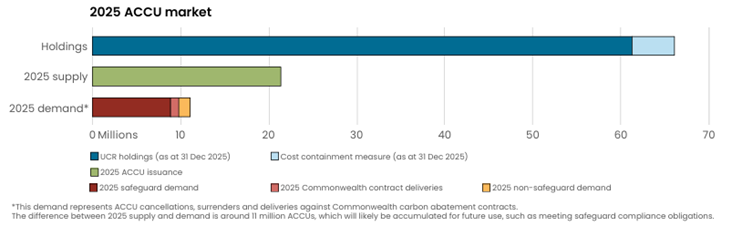
It is expected that demand from the SM will continue to ramp up as the relevant facility baselines decline as we approach 2030. Key to satisfying the demand during this period, and post 2030, will be the ACCU supply, which is heavily dependent on method development and accessibility (see below).
Quarterly regulatory compliance update
The CER publishes quarterly regulatory compliance updates, which detail compliance priorities and regulatory action taken during the previous quarter.
In its latest regulatory compliance update, the CER emphasised the notification requirements under the ACCU Scheme, and in particular the need for proponents to notify the CER of any significant disturbance events leading to reversal of carbon stocks. A reversal of carbon dioxide removal caused by natural disturbances is “significant” if the size of the project area in which the reversal occurs is at least 5 per cent of the total project area (or, if caused by human conduct, affects an area of at least 50 hectares). Carbon Credits (Carbon Farming Initiative) Rule 2015 rr 81, 82.
In the last quarter, three proponents notified the CER of significant fire disturbance events and 18 notified the CER of disturbances relating to flood events. The CER noted that it uses remote sensing to monitor fire scars and it will detect if proponents do not notify it of fire-related disturbances. Proponents should be aware that a failure to notify the CER of relevant events can undermine their ‘fit and proper person’ status.
The CER has also launched a new Notify the Regulator form in its Online Services platform to streamline notifications relating to projects, changes or issues.
Compliance deadline
The next compliance deadline under the reformed SM is 31 March 2026.
By then, responsible emitters of SM facilities must ensure that an “excess emissions situation” does not exist in relation to their facility. An “excess emissions situation” occurs when a facility’s “net emissions number” exceeds its “baseline”. This may require surrendering prescribed carbon units (ie ACCUs or Safeguard Mechanism Credits (SMCs)) to achieve compliance. Responsible emitters that need to surrender significant volumes of prescribed carbon units should look to acquire these as soon as possible, if they have not already done so.
Emitters with an excess emissions situation existing after the compliance deadline risk attracting a penalty of up to A$49.5 million. National Greenhouse and Energy Reporting Act 2007(Cth) s 41(2). The penalty is determined by whichever is the lesser of either one third of the maximum penalty that a Court could impose on the person for that contravention or 150, 000 penalty units (currently one penalty unit is equal to A$330). The deadline for other statutory mechanisms which can be used to manage SM liabilities for the 2024-25 financial year, including exemption declarations and multi-year monitoring periods, has now passed.
Review of the Safeguard Mechanism
The Government will review the SM in 2026-27 to ensure policy frameworks align with the country’s post-2030 emissions reduction trajectories and the ratcheted 2035 national climate target (which is a reduction of 62 per cent to 70 per cent against 2005 levels) (2035 Target) (SM Review).
The SM Review will consider two years of data (since the 2023 reforms) and will explore how policymakers can drive long-term progress towards net zero and, more broadly, align with the objects of the National Greenhouse and Energy Reporting Act 2007 (Cth). The scope of the SM Review will include:
- Baseline decline values
- The use of international units to satisfy compliance obligations
- Arrangements for emissions-intensive, trade-exposed activities
- Impacts of carbon border adjustment mechanisms (such as that implemented by the EU)
- Commercial readiness and viability of technology to reduce emissions
- Comparison of carbon efficiency of these facilities to competing import facilities
- Sufficiency of the cost containment measure (currently $82.68 per ACCU for FY 2025-26)
- Suitability of borrowing adjustment determination provisions
- Use of SMCs and other offsets beyond 2030
- Whether any competitive neutrality issues have arisen with the coverage arrangements
National Greenhouse and Energy Reporting (Safeguard Mechanism) Amendment (Reforms) Rules 2023 - Federal Register of Legislation
As part of the SM Review, the Climate Change Authority (CCA) will advise the Australian Government on the extent to which onsite abatement is influenced by the reforms and the necessity of additional incentives (such as managing ACCU price and availability). See Safeguard Mechanism overview - DCCEEW
ACCU Scheme reforms
Continued reform of the ACCU Scheme is crucial to maintaining and strengthening its integrity. The CCA is responsible for reviewing the Carbon Credits (Carbon Farming Initiative) Act 2011 (Cth) every three years to ensure it remains fit for purpose and supports Australia’s national emissions reduction targets.
The CCA is preparing its fifth review of the ACCU Scheme (ACCU Scheme Review) in the context of the 2035 Target, the 2023 SM reforms and international trading of offsets under Article 6 of the Paris Agreement. Article 6: Opportunities for the private sector | Australia | Global law firm | Norton Rose Fulbright It will also consider how to improve its operation, uphold public confidence in the ACCU Scheme and achieve Australia’s emissions reduction goals.
Changes to the ACCU Scheme in 2026 will include the development of new methods (and the retirement of methods which are expiring this year). The ACCU methods currently under development include: ACCU method tracker - DCCEEW
- Extending savanna fire management (SFM) to the northern arid zone method.
- Reducing the disturbance of coastal and floodplain wetlands by managing ungulates method.
- Improved native forest vegetation in multi-use public native forest method.
- Improved avoided clearing of native regrowth method.
- An updated SFM emissions avoidance method, and a sequestration & emissions avoidance method.
- Integrated farm and land management method (IFLM Method).
A draft of the IFLM Method was released on 22 December 2025 and the Emissions Reduction Assurance Committee is accepting submissions on this until 9 March 2026.
The ACCU methods which are expiring this year include:
- High efficiency commercial appliances method (31 March 2026).
- Refrigeration and ventilation fans method (31 March 2026).
- Source separated organic waste method (31 March 2026).
Considering these methods have generally low engagement (with a total of 33 projects and 21,000 ACCUs issued between them), their expiry is unlikely to significantly impact upon ACCU supply.
The Government has recently released its Reforming the ACCU Scheme Progress Report 2023-2025 (Progress Report) demonstrating the Government’s renewed commitment to improving the ACCU Scheme in line with the recommendations arising from various independent reviews, including the Chubb Review (see our article discussing the Chubb Review here).
The Progress Report summarises the work of the CER and Department of Climate Change, Energy, the Environment and Water on the ACCU Scheme to date and the upcoming reform priorities and focus areas.
A key priority in reforming the ACCU Scheme is developing the legislative amendments to the CFI Act. An important amendment will be the removal of the option for projects to be conditionally registered on Native Title land. It is also proposed that the Minister will be given the power to direct project proponents to move to a varied or changed method in certain circumstances (this choice is currently voluntary).
Furthermore, the CFI Rule is due to sunset on 1 April 2027, prompting preparation for its re-make. It is proposed that consultation on the re-making of the Rule will take place this year.
Australia’s Carbon Leakage Review
In February, the Government published the final report under its Carbon Leakage Review, which assessed both the risk of carbon leakage under Australia’s current climate framework and potential solutions to mitigate this risk. The Review is to be considered as part of the SM Review to increase efficiency of the industrial transition towards net zero, boost Australia’s opportunities in low-emissions commodities and away from protectionist markets.
The Carbon Leakage Review incorporates feedback from two consultative processes and found that existing policies are effective at mitigating the risk of carbon leakage in the short to medium term. Where material risk does exist – for example, in relation to commodities such as cement, ammonia, steel and iron, and glass – the Carbon Leakage Review recommended that the suitability of trade-exposed baseline-adjusted (TEBA) arrangements for these commodities (under the SM) be considered as part of the SM Review.
The Review considered the feasibility of border carbon adjustments as an appropriate policy measure to address carbon leakage. It found that such mechanisms could be appropriate on imports of certain Safeguard covered-commodities (and might enable the removal of TEBA provisions) but that a border carbon adjustment on exports would be “inconsistent” with Australia’s emissions reduction targets and could raise international trade law concerns. See Carbon Leakage Review Final Reportfor further information.
The principles guiding the Carbon Leakage Review seek to position Australia as a major producer and exporter of clean energy and industrial commodities. The recommendations are designed to promote a durable market-based system incentivising investments in low and zero emission industries.
Next steps
The suite of upcoming developments is an opportunity for Australia to ensure its carbon trading and emissions mitigation regulatory frameworks are fit-for-purpose, having regard to Australia’s committed emissions reduction targets. They will also impact on entities operating in the ACCU Scheme and facilities covered by the SM. If you would like further information on how the upcoming reviews and deadlines may affect you, please contact a member of our climate change and carbon markets practice.