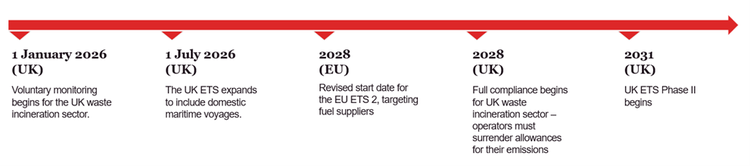
Carbon pricing in Europe is entering a new phase. Both the EU Emissions Trading System (EU ETS) and the UK Emissions Trading Scheme (UK ETS) are expanding their emissions trading systems (ETS) to cover new sectors, while introducing broader carbon measures to protect competitiveness. Key changes include:
- UK ETS maritime inclusion will begin July 2026.
- UK ETS will expand to include energy-from-waste and incineration plants.
- The second period for UK ETS free allocation has been delayed to 2027.
- UK ETS extends the qualification criteria for installations with low levels of emissions and companies can apply to be classed as ultra-small emitters for the 2026-2030 period.
- UK ETS Phase II confirmed for 2031–2040.
- EU ETS2 will be delayed to 2028.
Businesses must therefore prepare for tightening caps, rising carbon costs and evolving compliance obligations.
United Kingdom: Upcoming Changes Explained
Maritime Sector Inclusion
On 25 November 2025, the UK ETS Authority confirmed that domestic maritime voyages will enter the scheme on 1 July 2026. This timetable reflects the complexity of integrating a new sector and means the UK will implement the measure over two years later than the EU.
- Scope: Applies to vessels of 5,000 gross tonnage and above on domestic routes, mirroring the EU threshold for comparability.
- First Compliance Year: A shortened period from July to December 2026.
- Business Impact: Operators must install monitoring systems, train personnel, and budget for allowance purchases.
Waste Incineration
****The UK ETS will expand to include energy-from-waste and incineration plants, targeting fossil-derived emissions such as plastics.
- Voluntary Monitoring Phase: Begins 1 January 2026. Operators should measure, report and verify emissions to the UK ETS Authority but will not yet incur financial liability.
- Full Compliance: From 2028, operators must surrender allowances for verified emissions.
- Scope: The inclusion threshold for waste incineration will be based on the small waste incineration plant throughput threshold. This means that installations incinerating non-hazardous waste with a capacity exceeding 3 tonnes an hour, or, incinerating hazardous waste with a capacity exceeding 10 tonnes a day, will be in scope of the voluntary monitoring phase only.
Long-Term Policy Signal: UK ETS Phase II
In December 2025, the UK ETS Authority announced the extension of the scheme into a second phase, which will run from 2031 to 2040. This provides the long-term investment signal required for heavy infrastructure projects such as carbon capture and storage, hydrogen production and industrial decarbonisation. The confirmation that carbon pricing is a permanent fixture of the UK economy should give businesses the confidence to make significant capital investments in low-carbon technologies, knowing that the regulatory framework will remain in place and that carbon prices are likely to continue rising as the cap tightens.
The announcements of Phase II also indicates that the UK ETS Authority intends to maintain policy continuity and to avoid the stop-start regulatory changes that can undermine business confidence. For sectors with long asset lives, such as power generation and heavy industry, this long-term commitment is critical to investment decision-making.
European Union: Upcoming Changes Explained
Maritime Sector
Maritime transport has been part of the EU ETS since January 2024, covering vessels of 5,000 gross tonnage and above. The system applies to 100 per cent of emissions for intra-EU voyages and 50 per cent of emissions for voyages between EU and non-EU ports, reflecting the complexity of attributing emissions outside EU territorial waters. The inclusion is being phased in: 40 per cent of emissions were priced in 2024, rising to 70 per cent in 2025, and will reach full coverage in 2026. From 2026, methane (CH₄) and nitrous oxide (N₂O) will also be included.
ETS2: Buildings and Road Transport
The EU is introducing a separate emissions trading system, ETS2, to cover fuel combustion in buildings, road transport, and small industry not currently regulated under the existing ETS.
- Start Date: Postponed from 2027 to 2028.
- Compliance Design: Unlike the current ETS, which regulates end users, ETS2 targets fuel suppliers. However, costs are likely to be passed through to consumers via fuel and heating bills.
- Implications for Businesses: Fuel distributors must implement new compliance infrastructure and manage cost pass-through strategies.
- ETS2 is expected to incorporate a price‑stability mechanism designed to safeguard consumers. If the carbon price exceeds €45 per tonne, the system will trigger an enhanced top‑up, releasing twice the usual volume of additional allowances to moderate the price.
Key dates
Clients should be advised of the following critical implementation dates arising from the policy updates in 2025.