Information correct as of 26 March 2026.
Focus on: Australia
Market overview
Technical studies have shown that Australia has some of the best wind resources in the world, with the ability to support 2,000 GW of power. In 2021, the Commonwealth Government sought to capitalise on this potential by passing the Offshore Electricity Infrastructure Act 2021 (Cth) which provides a regulatory framework for the development, construction, operation and decommissioning of offshore renewables and offshore electricity transmission.
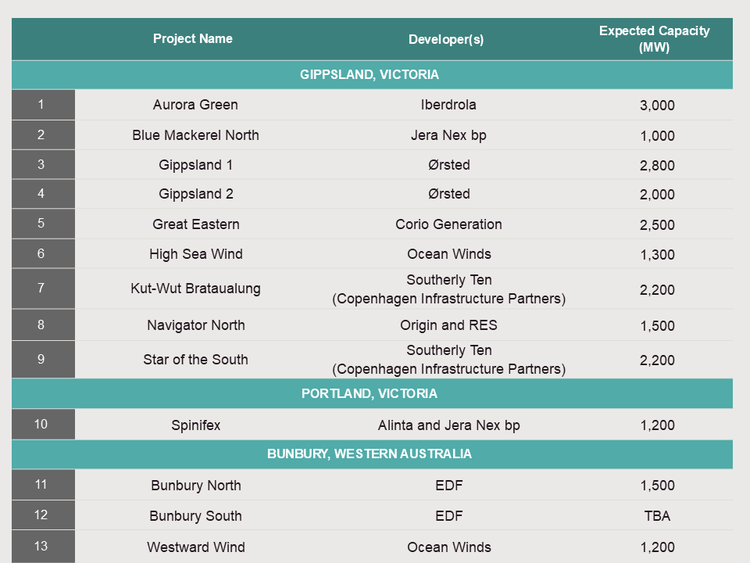
Since then, there has been a slew of regulatory instruments introduced to further build-out the regulatory framework. Between December 2022 and December 2024, following mandatory consultation periods, the Commonwealth Government declared six areas to possibly host offshore wind: Gippsland (Vic), Hunter (NSW), Southern Ocean (Vic), Illawarra (NSW), Bass Strait (Tas) and Bunbury (WA). Feasibility licences, which allow proponents of commercial projects to undertake feasibility and certain project development activities for their proposed offshore wind farms, have been issued to proponents in the Gippsland (12),1 Southern Ocean (1) and Bunbury (3) areas following competitive tender processes (see section 2 below for a complete list of projects).
Unlike other jurisdictions around the world, Australia does not yet have a government-backed, nation-wide offtake framework for offshore wind. Furthermore, given the offshore zones are controlled by the Commonwealth, there is also the need for state laws to be passed and harmonised with the federal offshore regulatory framework summarised above in order to enable progress.
In this respect, Victoria leads the way with state-based, policy and regulatory development. Offshore Wind Energy Victoria (OWEV), the state’s designated government agency, has released four implementation statements which, amongst other things, explicitly target 2 GW of offshore wind capacity by 2032, 4 GW by 2035 and 9 GW by 2040. The state has also taken some steps towards developing a Victorian offshore transmission licensing regime which is intended to work in concert with the federal offshore transmission regime. After an initial delay due to uncertainty regarding the availability of government funding, Victoria’s first offshore wind auction is due to kick-off in August 2026. Many of the proponents in the Gippsland area are well progressed with their environmental impact assessments and have had feasibility management plans, an integrated risk management document, approved by the regulator.
The other most active state is Western Australia, which as mentioned above, hosts three feasibility licences in the Bunbury region. The Western Australian Government has taken some initial steps to support the industry's development including establishing an inter-agency working group, conducting regulatory readiness reviews, investing in local wind energy manufacturing capability, and advocating for co-existence with existing marine users.
Commercial Projects holding a feasibility licence
Key Challenges
Auction clarity and financing challenges
The Victorian Government initially planned for its first offshore wind auction process to commence in September 2025, however, just prior to the scheduled commencement a postponement was announced. Simultaneously, the Commonwealth Government, in recognition of the potential implications of the auction’s delay, sought to ease early-stage cost pressures by announcing a two‑year waiver for feasibility licences annual levies; however, this did not prevent some project withdrawals and pauses in Gippsland. These withdrawals and pauses have to some extent reduced competitive tension and supply-chain momentum leaving the surviving proponents to carry a higher development burden.
The Victorian Government has confirmed that the revised auction will:
- Be for 2GW.
- Be supported by the Electricity Services Entry Mechanism (ESEM), which is a reform coming out of the Nelson Review.
- Target 2032 for operations.
- The request for tender will be put out in August.
The key commercial terms are yet to be announced. It therefore remains to be seen whether the new ESEM contract structure, the details of which are currently being considered, will provide the revenue certainty required for Australian offshore wind projects to be bankable.
Offshore wind projects in Australia face some difficult economic and financing challenges. The CSIRO’s GenCost report affirms that offshore wind remains relatively expensive in Australia by comparison to onshore options.2 Victorian wholesale prices are also relatively low, and below the strike price in the UK’s recent AR7 auction, which has the benefit of a mature supply chain. Moreover, there are lingering concerns regarding global supply‑chain inflation and execution risk.
Ports
Port infrastructure remains a key pacing item in Victoria. The Port of Hastings, which was slated by the Victorian Government as the State’s designated offshore wind assembly port, had its Environment Protection and Biodiversity Conservation (EPBC) Act referral refused for having “clearly unacceptable” environmental impacts. A modified EPBC Act referral was re-submitted in June 2025. Despite this setback, the Victorian Government appears to be persisting with this plan, though, has at the same time stated that “the role of other ports in supporting offshore wind is also being assessed”.3 They note that ports “that are close to the declared offshore wind zones, such as Barry Beach Marine Terminal or Port Anthony in Gippsland, are well placed to meet the operations and maintenance needs of offshore wind developers”.4
Transmission
Transmission and system readiness is another key concurrent deliverable for offshore wind. Connecting offshore wind farms off Gippsland to the Victorian transmission system remains under development with VicGrid progressing through route refinement, environmental assessment, and procurement. However, this shared transmission solution, like the revised auction, is aligned with the Victorian Government’s initial 2032 target and will only support 2GW.5 A stage 2 transmission loop project is proposed to connect additional offshore wind generation from the Gippsland area to meet Victoria’s 2035 and 2040 offshore wind targets and is expected to be delivered between 2033 and 2038.6 A third phase, due to be delivered by 2038 is the uprating of existing lines from Heywood to Portland to connect offshore generation from the Southern Ocean offshore wind area to Portland.7 This setting would seemingly set the pace for offshore wind development in Victoria.
Moreover, in 2024, the Australian Energy Market Commission identified several regulatory barriers in the national electricity rules which will need to be overcome to facilitate the delivery of offshore electricity infrastructure.8 To date, there has been limited substantive progress on these identified reforms.
Footnotes
-
Three proponents in Gippsland have surrendered their feasibility licences.
-
CSIRO, GenCost 2025-26 (Consultation Draft, December 2025).
-
Ibid.
-
Ibid.
-
Ibid.
-
Australian Energy Market Commission, Offshore electricity infrastructure analysis (17 October 2024)