Information correct as of January 2026.
Focus on: Canada
Market overview
Canada has great potential for offshore wind development due to the quality resources on its coasts and offshore. While no offshore wind projects have been built in Canada to date, market conditions are improving as a result of the recent introduction of legislative and regulatory changes, which are expected to pave the way to an offshore wind market on Canada’s Atlantic coast, and significant federal government financial commitments and incentives with respect to clean energy development. Subject to permitting and market conditions, Canada is expected to see the completion of its first-ever offshore wind farm in Nova Scotia in 2030.
Onshore wind power accounts for 7.7 percent of Canada’s total electricity capacity. Along with solar photovoltaic, Canada also counts wind energy as one of its fastest growing renewable energy sources, likely due to its highly scalable nature. Canada’s onshore wind capacity has grown from eight wind farms in 1998 to 371 in 2025, with an installed capacity of over 18 gigawatts (“GW”). This is due in large part to the strong historic wind leadership demonstrated by Ontario, Alberta, and Québec, as the nation’s leading wind markets.
Policy in relation to offshore wind continues to develop in Canada, particularly as it relates to Canada’s East Coast. As of August 28, 2019, the Canadian Energy Regulator Act (the “Act”) is in effect governing the Canadian energy sector, including offshore wind. The Offshore Renewable Energy Regulations (“ORERs”), which came into force on December 16, 2024, is aimed at supporting the implementation of this Act with respect to offshore renewable energy projects. The Act also effected a renascence of the National Energy Board as the Canada Energy Regulator (“CER”) with a new mandate that covers emerging energy developments such as regulation of offshore renewable energy.
The accelerating pace of change to the regulatory regime for offshore wind in Atlantic Canada is noteworthy. On January 31, 2025, the federal government announced the coming into force of Bill C-491. In partnership with the governments of Nova Scotia and Newfoundland and Labrador, this legislation will facilitate offshore wind development for the first time in the provinces of Nova Scotia and Newfoundland and Labrador, by amending the existing frameworks governing the joint federal-provincial management of offshore petroleum resources. The amendments under Bill C-49 expand the regulatory authority under those frameworks to offshore wind power, generally modernize regulation of offshore energy resources in Nova Scotia and Newfoundland and Labrador, and provide added certainty and consistency with respect to the approvals process to potential developers, financiers and other stakeholders.
In September 2024, the government of Nova Scotia adopted Bill 471,2 legislation mirroring Bill C-49. Together, Bill 471 and Bill C-49 establish a common framework for the federal and Nova Scotia governments, including mechanisms to streamline the development and management of offshore wind energy projects. The government of Newfoundland and Labrador’s mirror legislation, Bill 90, came into force on June 2, 2025. This legislation expands the mandate of the Canada-Newfoundland and Labrador Offshore Energy Regulator to include offshore renewable energy development.
Canada: Offshore Wind Projects
East Coast
Canada’s Atlantic region is uniquely positioned for Canada’s efforts toward developing offshore wind projects, with offshore average wind speeds being some of the highest globally. Through the joint legislative framework established by Bill C-49 and Bill 471, the governments of Canada and Nova Scotia intend to offer leases for five GW of offshore wind energy by 2030 in support of green hydrogen production. The leases will be granted through a competitive bidding process, jointly managed by the provincial and federal governments, with the first call for bids scheduled to be issued before the end of 2025.
Nova Scotia has significantly expanded its offshore wind ambitions with the $60-billion Wind West initiative, with the aim of generating up to 66 GW of installed capacity, surpassing previous targets. The newly established Major Projects Office of Canada3 will support the advancement of transformative projects of “national importance”, including Wind West.
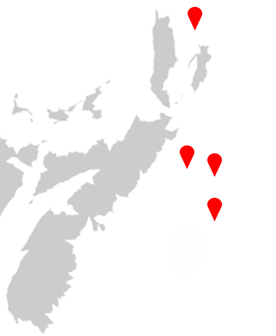
In July 2025, the governments of Canada and Nova Scotia officially designated Canada’s first offshore wind energy areas on Nova Scotia’s offshore: French Bank, Middle Bank, Sable Island Bank and Sydney Bight, each off the coast of Cape Breton. As of 2025, the Canada-Nova Scotia Offshore Energy Regulator has initiated the first phase of a licensing process for the designated sites off the shore of Nova Scotia and the governments of Canada and Nova Scotia have directed the Canada-Nova Scotia Offshore Energy Regulator to begin a prequalification process and call for information in anticipation of a bidding process for an initial 3 GW of offshore wind power. While these developments move Canada closer to the creation of an offshore wind market, the ultimate success of the project still depends on key variables such as transmission infrastructure, market access, and rising costs, as well as continued regulatory support and Indigenous engagement.
Located off Goldboro, Nova Scotia, the Nova East Wind Project, with a projected generation capacity of 300 to 400 megawatts (“MW”), could be the first offshore wind farm in Canada. The project would use existing undersea cables leftover from the abandoned offshore natural gas sector to bring clean electricity to shore. In 2024, developers signed a Memorandum of Understanding with the Assembly Nova Scotia Mi’kmaw Chiefs, establishing a framework for the development, installation and operation of the project. Publically available information confirms that the project has begun the Impact Assessment consent process and is targeting 2027 for approval.
As of March 7, 2025, the governments of Canada and Nova Scotia put a moratorium on the planned offshore wind project at Georges Bank in Newfoundland and Labrador, developed by Atlantic Canada Offshore Developments (“ACOD”).4 Natural Resources Canada announced that the moratorium is aligned with the federal and Nova Scotia governments commitment to sustainability, as well as the fisheries industry, in its development of offshore resources. The offshore wind moratorium in Georges Bank will expire in 2032.
The planned Sea-Breeze Tech Demonstration Project in Nova Scotia, to be developed by Brezo Energy, has a proposed generation capacity of 100 MW. The project is in early-stage development, with operations expected to start in 2029.
West Coast
In 2020, it was announced that Oceanic Wind (formerly NaiKun Wind Energy Group) sold the development rights of their offshore wind project located in Hecate Strait between Haida Gwaii and Prince Rupert in British Columbia to Northland Power Inc. In September 2023, the control and ownership of the Hecate Strait project were returned to Oceanic Wind. The project has received the necessary Environmental Assessment Certificates from the provincial and federal governments for the first phase of the project, 300 MW to 400 MW. Fully developed in phases over many years, the wind resource in Hecate Strait could provide in excess of two GW of power. To accelerate the procurement of clean energy in the province, the government of British Columbia announced in December 2024 that all future offshore wind projects will be exempt from comprehensive environmental assessment processes in British-Columbia.5 In July 2025, Oceanic Wind announced that, in partnership with Coast Tsimshian Enterprises Ltd., the project had progressed to the first phase of development, which involves investigation and data collection on Crown land. Coast Tsimshian Enterprises Ltd. is a joint venture between the Metlakatla and Lax Kw’alaams First Nations.
Canada: Development process
Notes:
- The coming into force of Bills C-49, 471 and 90 streamlines the regulatory regime and processes for offshore wind development in the provinces of Nova Scotia and Newfoundland and Labrador by leveraging the existing regulatory framework for single joint federal-provincial regulation of offshore petroleum resources.
- The Canadian Energy Regulator Act has been in effect since August 28, 2019 and the National Energy Board became the CER. Together with the Canada Offshore Renewable Energy Regulations, these initiatives are part of the federal government’s legislative framework for a sustainable Canadian energy sector, which includes offshore wind.
- Ontario historically had a regime for offshore wind power development in the Great Lakes. Several applications have been made for energy contracts to develop offshore wind project, but a moratorium was imposed on new projects in 2011.
Canada: Opportunities
Emerging renewable energy market
- Significant development opportunity along the coast of the Gulf of Saint Lawrence and on both the Atlantic and Pacific coastlines.
- Excellent environmental conditions – shallow water close to land and consistent, strong winds.
- Existing infrastructure and a strong industrial base – skilled workforce with transferable skills, suitable deep water ports (serving as supply and service hubs), and offshore experience (from oil and gas industry).
- Green hydrogen production using renewable electricity sources such as onshore and offshore wind, a clean alternative to fossil fuels which does not produce greenhouse gas emissions.
- Accelerating commercial-scale hydrogen trade between Canada and Germany placing Canada pursuant to the Memorandum of Understanding signed on March 18, 2024 under the Canada–Germany Hydrogen Alliance, which aims to secure early access to the German market for Canadian hydrogen producers and make Canada a priority market for Germany to source clean hydrogen.
- Ideal storage locations and geographic advantage for international shipping of green hydrogen from the Atlantic coastline, allowing Canada to export green hydrogen abroad, including to Germany under the Canada–Germany Hydrogen Alliance.
- As new members to the Global Offshore Wind Alliance, the governments of Canada, Nova Scotia and Newfoundland and Labrador will gain access to international expertise, strengthening offshore wind development in Canada.
Reduce reliance on natural gas imports from the United States may help mitigate exposure to cross-border trade dynamics, including potential tariff changes, while supporting domestic energy diversification.
Access to domestically sourced components
- The foundations and certain other components may be sourced domestically.
- While installation and interconnection would most likely be sourced internationally, a local workforce is available to attend to onshore and offshore support activities.
- A large part of substation design work, equipment and materials may be sourced locally.
- Maintenance and inspection services – oil and gas experience in offshore logistics can shape evolving strategies in offshore wind.
Commitment to green energy
The federal government has introduced policies aimed at promoting the use of renewable resources such as the Powering Canada Forward: Building a Clean, Affordable, and Reliable Electricity System for Every Region of Canada published in August 2023, followed by the Powering Canada’s Future: A Clean Electricity Strategy, published in December 2024. In 2022, the federal budget allocated $250 million over four years to support pre-development activities of clean electricity projects on the national scale, as well as inter-provincial electricity transmission projects. The 2022 federal budget also committed $600 million over seven years to support renewable electricity and grid modernization projects. Offshore wind projects are considered eligible projects for this funding, subject to certain requirements and criteria. Newfoundland and Labrador has received federal funding for several renewable energy research projects, including a project using floating wind turbines to power oil and gas assets.
In 2023, the federal government committed significant financial resources in the form of monetary investments and investment tax credits (“ITC” or “ITCs”) to support the development of green energy in Canada, including offshore wind. The ITCs available6 include:
- Clean Technology ITC: Worth up to 30% of capital cost of investments in wind, solar photovoltaic, and energy-storage technologies;
- Clean Hydrogen ITC: Worth between 15% and 40% of capital cost of investments in green hydrogen production, assessed based on produced carbon intensity;
- Clean Manufacturing ITC: Worth up to 30% of capital cost of investments in clean technology manufacturing, including wind energy equipment; and
- Clean Electricity ITC: Worth up to 15% of capital costs of investment in non-emitting electricity generation systems, including wind.
The 2024 federal budget provided additional details with respect to the design and implementation of certain ITCs.
In addition, eligible businesses will be able to benefit from the existing Atlantic ITC, worth up to 10% of the capital cost of investment in wind energy conversion systems. Specifically, the Canada Infrastructure Bank will be investing $20 billion to support the development of major clean electricity and clean growth infrastructure projects. Expanding on commitments set out in the 2023 and 2024 federal budgets, the 2025 federal budget (released in November 2025), the 2025 federal budget identified offshore wind as part of large-scale, nationally significant energy infrastructure assets and incorporates offshore wind into Canada’s broader clean-energy transition and power grid modernization strategies. The 2025 federal budget also confirms the federal government’s intention to finalize and legislate the Clean Electricity Investment Tax Credit, which applies broadly to renewable energy projects, including offshore wind.
In February 2025, the governments of Canada, Nova Scotia and Newfoundland and Labrador joined the Global Offshore Wind Alliance (“GOWA”). Through GOWA, Canada will benefit from access to international and industry knowledge that will help accelerate offshore wind development.
Canada: Challenges
Permitting and regulatory challenges
With the exception of Atlantic Canada, which now benefits from added clarity and certainty following the regulatory changes flowing from Bill C-49, a mixture of federal and provincial approvals will be required to construct and operate an offshore wind project in the rest of Canada, including Canada’s west coast. Both the federal and provincial approvals process will likely require projects to go through an environmental review process. While numerous federal statutes and regulations govern many activities in federal offshore areas, the Act is the legislative framework for the administration of renewable projects, including offshore wind projects. Through the Offshore Renewable Energy Regulations Initiative, Natural Resources Canada (“NRC”) has announced the coming into force of the Canada Offshore Renewable Energy Regulations, which establish a framework respecting modern safety and environmental protection for offshore renewable energy projects. NRC intends to replicate the ORERs under the joint Canada-Nova Scotia and Canada-Newfoundland and Labrador regimes.
The approval processes for offshore wind projects in Nova Scotia and Newfoundland and Labrador will be significantly improved through the expanded regulatory mandates proposed by Bill C-49, alleviating some of the challenges that arise from dual federal/provincial jurisdictional management by allowing developers to obtain all necessary approvals through a joint singular regulator, rather than dealing with provincial and federal authorities separately. On September 26, 2025, the government of Nova Scotia introduced the Powering the Offshore Act, which provides a framework for developing offshore energy and for energy produced by offshore wind projects to be purchased and used domestically.
While British Columbia has exempted offshore wind projects from comprehensive environmental assessments, there are currently no publicly known plans to modify the existing regulatory regime in the same manner as is being undertaken in Atlantic Canada.
First Nation - Duty to Consult
Canada’s Constitution recognises and affirms existing Indigenous and treaty rights and thus they benefit from special protection in law. The Crown has a constitutional duty to engage with Indigenous peoples in Canada in meaningful consultation and often accommodation where its actions (including the issuance of regulatory permits) may adversely affect established or credibly asserted Indigenous and/or treaty rights. The Supreme Court of Canada has also confirmed that decisions related to permits or other approvals issued by a regulatory tribunal (including energy regulators) can trigger the duty to consult. In such cases (and subject to the legislation governing such regulator), the regulatory tribunal may consider that duty to consult through a regulatory hearing process.
The Offshore Wind Indigenous and Coastal Communities Grant Funding aims to support Indigenous and coastal communities in Nova Scotia and Newfoundland and Labrador by providing access to technical and professional resources necessary to engage with the offshore wind industry, regulators, public sector entities, and other stakeholders. This support is intended to enhance community knowledge and increase community participation in offshore wind-related consultations and engagements.
Footnotes
-
Bill C-49: An Act to amend the Canada-Newfoundland and Labrador Atlantic Accord Implementation Act and the Canada-Nova Scotia Offshore Petroleum Resources Accord Implementation Act and to make consequential amendments to other Acts (“Bill C-49”).
-
Advancing Nova Scotia Opportunities Act.
-
Major Projects Office of Canada: Initial Projects under Consideration - Canada.ca
-
[NTD: See Canada, Nova Scotia put moratorium on offshore wind at Georges Bank | Offshore Wind News | Renewables Now] \
-
[NTD: See Project Timeline | Oceanic Wind]
-
The federal government has proposed changes to the Income Tax Act related to these ITCs, which may come into effect retroactively when and if the proposed changes come into force. \