FDI Regime
Germany’s FDI regime in its current form has been in place since 2020 – Germany now accounts for more than 20 percent of all FDI filings made in EU Member States.2 In 2026, the FDI Screening Regulation ((EU) 2019/452) will be reformed at the European level. Within this framework, German FDI law is also expected to be reformed.
Foreign direct investment (FDI) screening in Germany is governed by the Foreign Trade and Payments Act (Aussenwirtschaftsgesetz or AWG) and the Foreign Trade and Payments Regulation (Aussenwirtschaftsverordnung or AWV).
The Federal Ministry for Economic Affairs and Energy (the Ministry) carries out the reviews in consultation with the Foreign Office, the Ministry of Defense and the Ministry of the Interior. Besides that, prohibitions of investments require the approval of the entire federal government.
Expected Reforms
The European Commission’s (Commission) draft regulation, that would fundamentally revise the EU FDI Screening Regulation (the FDI Regulation), is expected to be implemented by mid-2026 (the Proposal), with entry into force 18 months later. The Council and the European Parliament reached a provisional political agreement on the updated framework on December 11, 2025.3 The Proposal aims to harmonize and strengthen national screening mechanisms by introducing mandatory screening for certain critical sectors, including defense, semiconductors, AI, and quantum technologies. Member States would be required to ensure that acquisitions of at least 25 percent in sensitive sectors are subject to review (with Cyprus as the latest addition, all 27 Member States now have an operating FDI regime). The Commission would also gain the power to issue opinions in certain cross-border cases which have to be addressed by the respective Member State authority in its decision in case of disagreement. However, the Commission will not be able to overrule a decision issued by a Member State authority, as the decision-making authority will remain with Member States.
The Proposal would also introduce stricter cooperation obligations between Member States and the Commission, including mandatory notifications for a broader range of transactions and tighter deadlines. Notably, the Proposal would apply to both direct and indirect acquisitions, including those structured via EU-based intermediaries.
The Proposal marks a shift toward a more centralized and interventionist EU investment control regime, with significant implications for deal timelines and legal certainty.
In parallel, the German federal government is preparing a legislative reform to consolidate and streamline the national FDI screening framework, potentially publishing the first draft by mid-2026 (the German Proposal). The German Proposal is expected to introduce a number of substantive changes that could significantly expand the scope of review. The Ministry is also considering extending the regime to cover certain IP licensing and contractual arrangements that may enable the transfer of sensitive know-how without a share acquisition. Notably, the German Proposal may shift the test for foreign individuals from place of residence to nationality, close internal restructuring loopholes, and maintain the strict “non-dilution” principle for indirect shareholdings.
These changes, combined with faster timelines and more standardized procedures, would mark a significant evolution of Germany’s FDI screening regime and align with the EU’s approach for more thorough and efficient FDI regimes in Member States.4
Notification Thresholds
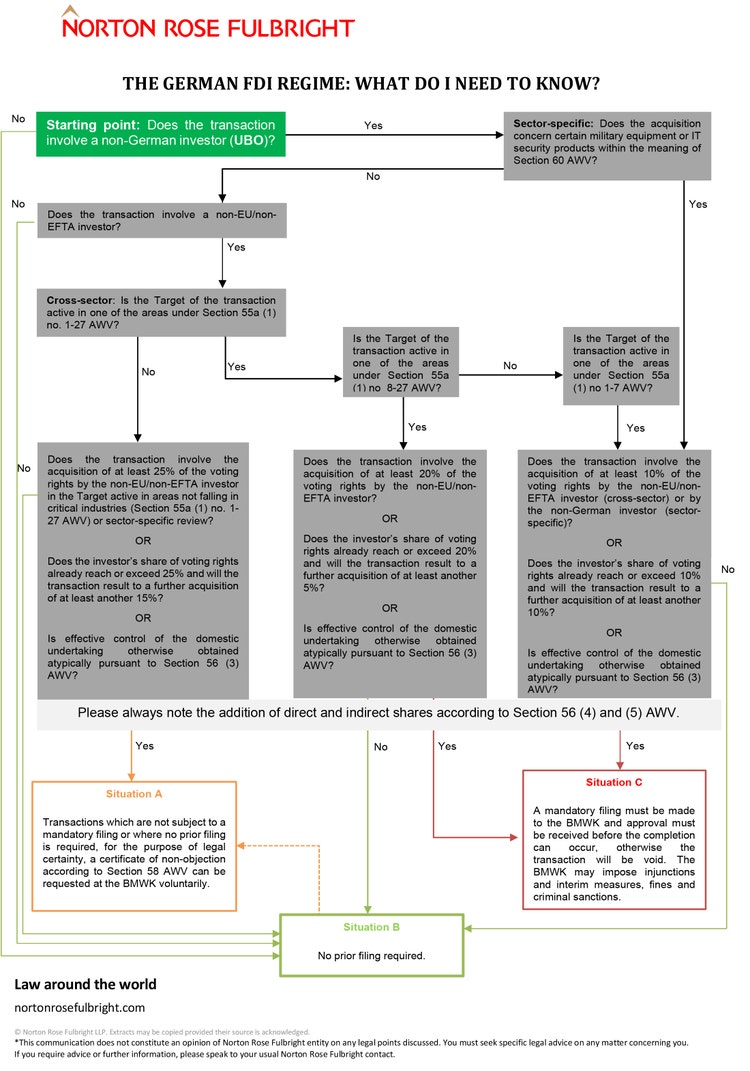
German law distinguishes between cross-sector and sector-specific reviews. The industry sector in which the target company is active and the nationality of the investor determines which procedure is applicable.
Sector-specific review
If the target is active in the defense or crypto technology sector, any acquisition by a non-German investor of at least 10 percent of the target’s voting rights is subject to a mandatory filing obligation (section 60a (1) AWV).The defense and crypto technology sectors include the manufacture and development of weapons of war, ammunition, military equipment and technology for processing classified government information, covering all military items listed in Part 1, Section A of the German Export List.
Cross-sector review
An acquisition in any of the 27 economic sectors within the scope of section 55a (1) AWV designated as “critical infrastructure” is subject to mandatory filing obligation if the voting rights threshold is met. Out of these 27 infrastructure sectors those mentioned in section 55a (1) No 1-7 AWV are considered to be especially critical and any acquisition by a non-EU or non-EFTA investor of at least 10 percent of the target’s voting rights in these sectors is subject to a mandatory filing obligation. These seven critical infrastructure sectors comprise, for example, energy, water, finance, healthcare or transport, telecommunications, cloud computing services, telematics or certain providers in the media industry.
If the target is active in any of the remaining 20 critical infrastructure sectors (section 55a (1) No. 8-27 AWV), a threshold of 20 percent applies. These include, for example, essential pharmaceuticals, artificial intelligence, robotics, semiconductors, cybersecurity, aerospace, quantum-based technologies and nanotechnology, in line with Article 4(1) of the EU FDI Regulation (2019/452).
Further, any acquisition of a German company active in any sector by investors located outside the territory of the EU or EFTA whereby investors acquire at least 25 percent of the company’s voting rights can be subject to a cross-sector review (regardless of the transaction value or turnover of the parties). In these cases filing is, however, voluntary.
Incremental share acquisitions
For both cross-sector and sector-specific reviews, incremental share acquisitions can trigger a notification obligation as well, even if the Ministry already approved the initial acquisition. In this regard, the government has set specific thresholds (20, 25, 40, 50 or 75 percent of the voting rights).
Atypical acquisitions
Investments resulting in an effective participation in a domestic company (so-called atypical acquisitions of control) through obtaining additional influence in supervisory bodies or management, veto rights on strategic decisions or rights to sensitive information are also subject to review. The notification of an atypical acquisition in a cross-sector review is voluntary whereas an atypical acquisition in a sector-specific review will be subject to a mandatory filing obligation.
The AWV explicitly empowers the Ministry to review transactions that appear designed to dodge FDI scrutiny. For example, if a non-EU buyer uses an EU-incorporated shell company or breaks the deal into smaller share tranches to stay below thresholds, the Ministry can still treat it as one acquisition and initiate a review.
Review Procedures
Any transaction for which a mandatory filing is required is subject to a standstill obligation until clearance is granted. Stock market transactions are exempt from the standstill obligation. They nevertheless remain subject to a notification obligation and the exercise of acquired voting rights as well as the exchange of sensitive information with the purchaser are prohibited until the investigation has concluded. Violations of the standstill obligation or the notification requirement may give rise to criminal liability on the part of the persons concerned and administrative liability on the part of the companies concerned. Transactions implemented in breach of a standstill obligation are provisionally invalid until the Ministry grants its approval. Investors can close transactions that are not subject to a mandatory filing obligation without waiting for approval, though transactions can be unwound or subjected to conditions retroactively.
In both cross-sector and sector-specific reviews, the authority has two months after obtaining knowledge about the acquisition either to approve the transaction or to open a second-phase investigation. If the authority does not open a second-phase investigation within two months, the transaction is deemed to be approved. A second-phase investigation must be completed within four months after receipt of complete documentation.
The deadline can be extended by three months in individual cases if the assessment procedure reveals particular actual or legal difficulties. An extension by a further month is possible if defence interests are affected. Procedural deadlines are suspended during any negotiations on possible commitments by the parties to obtain approval. In practice, review procedures in complex cases which may impair the public order or security of Germany may last for more than a year.
The Ministry has the power to call in cases ex officio. However, the opening of a review procedure is legally precluded five years after conclusion of the acquisition agreement.
In situations where a filing is voluntary, parties can request a certificate of non-objection to obtain legal certainty.
In 2025, only 2 percent of filings were either not approved or approved only with conditions (8 out of 339 filings). In only 31 cases (9.14 percent) was a Phase II investigation initiated.
Substantive Tests
As regards the standard for substantive assessment, in a cross-sector review, the authorities examine whether the acquisition is likely to impair the public order or security of Germany, another Member State of the European Union or projects or programmes of Union interest in the sense of Article 8 of the EU FDI Regulation. The authority can take into account the control exercised by foreign governments/public authorities over the acquirer; previous activities by the acquirer that damaged the public order or security of Germany or other EU Member States; and risks that the acquirer might be involved in specific criminal activities. In the case of a sector-specific review, the authority will examine whether essential security interests of Germany are likely to be impaired. If the Ministry concludes that the transaction is likely to generate undesirable effects (e.g. impairment of public order or security), it can prohibit it or approve it with conditions. Conditions can include the obligation to notify the Ministry of future incremental share acquisitions.
Regarding the defence sector, the German Federal Ministry of Defence has recently published new guidelines in which it specifies which effects of foreign investment it considers undesirable.5 Such direct ministerial communication indicates that investments in the defence sector could be subject to a higher degree of scrutiny soon. The ministry especially emphasizes the importance of the protection of know-how relevant to Germany’s defence capability. A Ministry’s decision can be appealed to the Administrative Court of Berlin.
Footnotes
-
Investment Screening in Germany: Facts and Figures, 15 January 2026, available here.\
-
Report from the Commission to the European Parliament and the Council, 14.10.2025, COM(2025) 632 final, p.4, available here.\
-
The Council’s press release offers a link to the provisional agreement, available here.\
-
Further procedural changes would include: (i) Harmonization of Member State notification requirements by restricting it to sensitive cross-border cases; (ii) strengthening cooperation (joint database) and improved transparency in cross-border investments; (iii) limitation of Phase I review period to a maximum of 45 days (non-extendable); (iv) for the time being, no mandatory notification requirement for greenfield investments.
-
See Federal Ministry of Defence, Investitionsprüfung beim Erwerb von Unternehmen der Verteidigungsindustrie, 29.01.2026, available here.