The shift in delivering renewable energy projects away from engaging a single contractor who takes full responsibility for the engineering, procurement, and construction aspects of a project (EPC contract model) to instead developers contracting directly with multiple specialised contractors for separate packages of work (split contract model) raises interesting issues concerning satisfying the principal contractor requirements under work health and safety (WHS) legislation1.
Key issues include identifying which entity (or entities) will be appointed as Principal Contractor, determining what works fall under their management and control, and ensuring these arrangements are properly documented within contracts and safety management systems.
Issues concerning Principal Contractor appointment have the potential to lead to disputes between parties, significant disruption and delay, and legal proceedings against entities and individuals for alleged breach of WHS legislation. There is particular liability exposure for the principal / developer given any invalid engagement of a party as a Principal Contractor is likely to mean that the principal / developer is deemed the Principal Contractor. Understanding and addressing these issues is critical for effective project delivery and for managing exposure to criminal liability under WHS legislation.
Different contract models explained
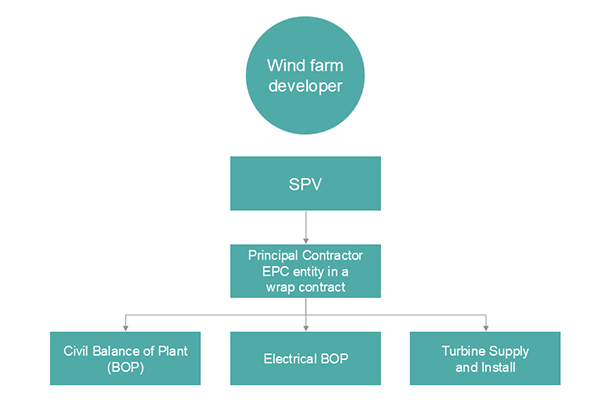
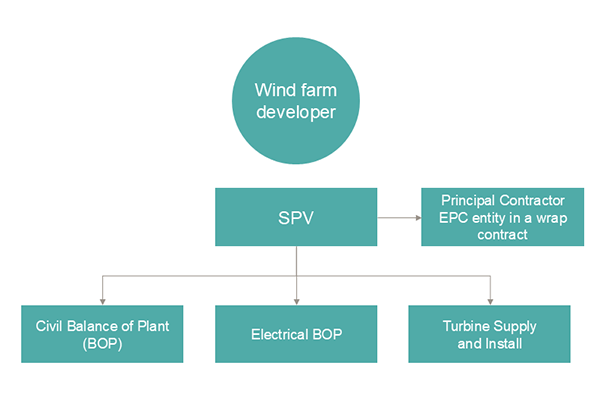
The diagrams below illustrate the split contract model compared with the traditional EPC contract model in the context of a wind farm development.
EPC model – One Principal Contractor through one contact
Split contract model – One or more Principal Contractors through multiple contracts
We also discuss these contract models in our August 2024 article “The BESS is yet to come: Legal trends in Australia’s large-scale battery sector” and our June 2025 article “Update on split contracting legal trends in Australia’s renewable energy sector”.
Principal contractor appointment
The term ‘Principal Contractor’ is defined in clause 293 of the WHS Regulations which relevantly provides:
- A person conducting a business or undertaking (PCBU) that commissions a construction project is, subject to this regulation, the Principal Contractor for the project.
- If the person referred to in subregulation (1) engages another PCBU as Principal Contractor for the construction project and authorises the person to have management or control of the workplace and to discharge the duties of a Principal Contractor under this Chapter, the person so engaged is the Principal Contractor for the project.
- A construction project has only one Principal Contractor at any specific time.
Clause 292 of the WHS Regulations defines a “construction project” as “a project that involves construction work where the cost of the construction work is $250,000 or more.”
The WHS Regulations impose a range of additional duties on a Principal Contractor (in addition to those of a PCBU). As set out above, these duties come into existence when there is construction works occurring that cost $250,000 or more and there can only be one Principal Contractor in relation to those defined works at any one time. Further, the Principal Contractor must have management or control of the workplace and discharge the duties of a Principal Contractor in relation to its works.
Principal Contractor appointment in a split contract model
There are different ways of satisfying the Principal Contractor duties under the WHS Regulations in a split contract model, including with one or multiple Principal Contractors. In considering the different options, developers need to consider which contractors have the competency to fulfil the Principal Contractor duties under the WHS Regulations, whether there are any contractors who would accept Principal Contractor responsibilities for another contractor’s scope of work or for the entire development, and whether the contractors can be given the necessary management and control of the workplace to meet the requirements for Principal Contractor appointment under the WHS Regulations.
Key issues and risks arising from the different approaches to Principal Contractor appointment in a split contract model are outlined below:
| Approach to Principal Contractor appointment in a split contract model | Key issues/risks | |
|---|---|---|
| One Principal Contractor (being one of the contractors who is undertaking development works) |
|
|
| Multiple Principal Contractors appointed for separate packages of work |
|
|
| One Principal Contractor (being a third-party project manager) |
|
|
Mitigation measures to address these risks include:
- Clear contractual provisions giving effect to the matters required for effective Principal Contractor appointment under the WHS Regulations that align with the agreed approach to Principal Contractor appointment.
- Development (and careful implementation) of safety systems and processes that support the approach to Principal Contractor appointment. If there are multiple Principal Contractors, this includes systems that provide clarity as to where management and control starts and ends for each Principal Contractor and how Principal Contractor responsibilities will be satisfied and risks managed at each interface.
- Supportive and cooperative engagement with the WHS regulator regarding Principal Contractor appointment. While a WHS regulator does not have the power to formally “approve” or “reject” a Principal Contractor model, in our experience, WHS regulators welcome transparency and engagement to assist them in effectively implementing their regulatory duties.
Our team at Norton Rose Fulbright is ready to assist our clients in navigating the challenges with Principal Contractor appointment under different contract models. For information on how we can assist you, please contact our team.
Footnotes
-
See for example, Work Health and Safety Queensland’s guidance page in relation to Principal Contractors under the heading “Only one principal contractor per construction project”.
-
This article refers to provisions of the model WHS Regulations, which form the basis of regulations adopted in all states and territories of Australia, except Victoria, with limited differences.